For this blog post, I read The Blood of Olympus by Rick Riordan.
The resolution of the main book's problem is a great way to end the series. Both Greek and Roman camps end up coming together and all of the demigods enjoy their lives. All of them have something to continue for and even Leo, found a place where he finds comfortable.
The structure of this book consists of two parts of the story. Two interdependent quests of defeating the rise of Gaea in Greece and returning the Parthenos to the camp. These quests rotate with characters as well, with Nico and Reyna returning the Parthenos, and multiple characters in the other quest. As the story progresses, we see many of the different character's problems and all of this combines into what ends up happening in the end of this series.
This story has a general genre of greek myths being incorporated into a fantasy book. The interesting part of this is the fact that I have read many Greek myths before. The first part is an allusion to The Odyssey, which I think is really amazing.
I was interested in this passage "But if Piper's visions were right, the suitors were now back, haunting the place where they'd died" (Riordan 7). This is a reference to the palace of Odysseus in Ithaca. When I first read it, I was amazed at the allusion that was in the other book that I had read before. Now, I think that this is a great book to extend with.
Sunday, October 26, 2014

Sunday, October 12, 2014
Continuation on The Oddysey
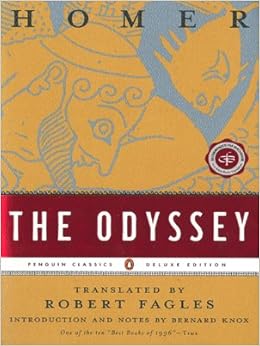
I made it all the way to book XVII of The Odyssey. The Odyssey has now reached a conflict that arises in the actual story of The Odyssey. After recanting his tale, Odysseus now returns home to reunite with his family. I liked how the author reversed the roles in the household. Odysseus returns home as a beggar to his own house. The suitors now are running his household, and Telemachus has finally reached his manhood. This irony is clearly intended as the new conflict is for Odysseus to win back his own home and driving the suitors out.
In chp. XV on page 195, the author says "As he was speaking a bird flew by upon his right hand-a hawk, Apollo's messenger. It held a dove in its talons, and the feathers as it tore them off, fell to the ground midway between Telemachus and the ship"(Homer 195). This is described as an omen, which is interesting enough. This is what led me to believe that Homer intentionally put it there for a reason, but an omen, or symbolization of what. I think this is the result of the conflict and maybe the climax. The hawk is symbolizing Odysseus, and the dove is the suitors being powerless under the hawk. Odysseus claims back his home as a fearsome hawk.
In chp. XV on page 195, the author says "As he was speaking a bird flew by upon his right hand-a hawk, Apollo's messenger. It held a dove in its talons, and the feathers as it tore them off, fell to the ground midway between Telemachus and the ship"(Homer 195). This is described as an omen, which is interesting enough. This is what led me to believe that Homer intentionally put it there for a reason, but an omen, or symbolization of what. I think this is the result of the conflict and maybe the climax. The hawk is symbolizing Odysseus, and the dove is the suitors being powerless under the hawk. Odysseus claims back his home as a fearsome hawk.
Saturday, September 27, 2014
The Beginning of an Odyssey
Even though the author titled the book Odyssey to symbolize Odysseus's trip back to Ithaca, really Telemachus also has a metaphorical odyssey. Telemachus definitely has a character development throughout the beginning of the book. After his father didn't come back after the war, and Telemachus's house is being usurped by the suitors of his mother, Penelope, he changes from a much more quiet and less audacious boy to a much more fierce person that is resulting from his "manhood" as he comes of age.
Homer describes Telemachus's bold statements when he stands up to the rowdiest of the suitors "If, on the other hand, you elect to persist in sponging upon one man, heaven help me, but Zeus shall reckon with you in full, and when you fall in my father's house there shall be no man to avenge you"(Homer 17). He actually stands up to the suitors, and even without his father there, he shows his bravery of trying to rid the suitors from the house by threatening them.
In chapters 3-4, Telemachus soon journeys on his own voyage as he visits Sparta to try and find the whereabouts of his father. One thing that I noticed is the common theme of hospitality and greeting of strangers in the culture of the Greeks. Even though it is a stranger from very far and they do not even know them, they welcome them in a great feast.
I am struck by Calypso's fiery speech against the gods "Now you are angry with me too because I have a man here...I got fond of him and cherished him... Still I cannot cross Zeus, or bring his counsels to nothing; therefore, if he insists upon it, let the man go beyond the seas again" (Homer 61) Calypso is complaining/ her reaction to the way the Gods worked, and that Zeus could dictate everything. This struck me as interesting because it told me the way things work, and her immediate response, hating the gods. Her speech immediately brings us pity and sadness of her desperate plight in her standard society.

Homer describes Telemachus's bold statements when he stands up to the rowdiest of the suitors "If, on the other hand, you elect to persist in sponging upon one man, heaven help me, but Zeus shall reckon with you in full, and when you fall in my father's house there shall be no man to avenge you"(Homer 17). He actually stands up to the suitors, and even without his father there, he shows his bravery of trying to rid the suitors from the house by threatening them.
In chapters 3-4, Telemachus soon journeys on his own voyage as he visits Sparta to try and find the whereabouts of his father. One thing that I noticed is the common theme of hospitality and greeting of strangers in the culture of the Greeks. Even though it is a stranger from very far and they do not even know them, they welcome them in a great feast.
I am struck by Calypso's fiery speech against the gods "Now you are angry with me too because I have a man here...I got fond of him and cherished him... Still I cannot cross Zeus, or bring his counsels to nothing; therefore, if he insists upon it, let the man go beyond the seas again" (Homer 61) Calypso is complaining/ her reaction to the way the Gods worked, and that Zeus could dictate everything. This struck me as interesting because it told me the way things work, and her immediate response, hating the gods. Her speech immediately brings us pity and sadness of her desperate plight in her standard society.
Subscribe to:
Posts (Atom)